
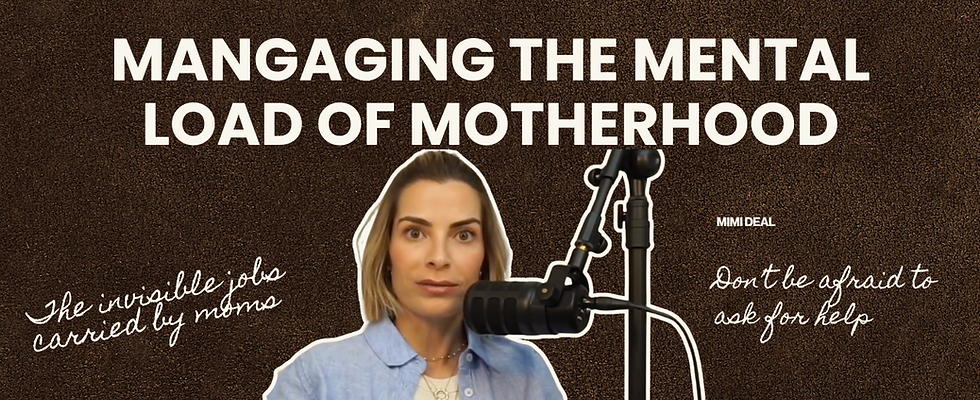
Have you ever been technically doing nothing, sitting on the couch, at dinner with friends, lying in bed, while your brain runs through everything you can't forget? That's the mental load, and today's episode is all about it.
The mental load of motherhood isn't the physical work of cooking, cleaning, and driving. It's the invisible layer underneath: the remembering, the anticipating, the planning, the checking, the worrying. I share the research showing this isn't just a feeling and talk about why invisible work is so exhausting, and the association researchers have found between an unequal mental load and higher stress, burnout, and lower wellbeing, while being honest that this research is observational.
Then we get practical, because awareness isn't enough. I share the strategies I'm testing in my own life: getting it out of your head, transferring ownership rather than just delegating tasks, letting go of the badge of honor around asking for help, real stress regulation (not another bubble bath), reducing daily decisions, and talking to yourself with more compassion.
And one important note I don't want lost: not every symptom is "just the mental load." Persistent exhaustion, anxiety, hopelessness, and changes in sleep deserve real evaluation, because depression and anxiety are common and treatable.
If you've felt this weight but never had a name for it, this one's for you. Share it with someone who needs it.
FAQs
What is the mental load?
The mental load is the invisible cognitive work of running a household, the remembering, anticipating, planning, and monitoring that happens behind the visible tasks. Making a doctor's appointment, for example, isn't just the phone call; it's noticing it's due, coordinating schedules, tracking the form, and remembering the next one. That thinking can occupy your mind for weeks, even when the task itself takes minutes.
Do mothers really carry more of the mental load?
Research suggests yes. Studies have found mothers report doing roughly 70 to 73% of the household's cognitive labor, a larger imbalance than for physical tasks. And notably, this gap doesn't reliably shrink when a woman has more time or resources, which suggests the issue isn't simply about efficiency or organization.
Why is the mental load so exhausting if I'm not "doing" anything?
Because cognitive labor is constant and invisible. You might be sitting still, but your mind is holding dozens of open loops that don't close when you switch activities. That ongoing background noise, worrying, tracking, and remembering at all hours, is genuinely draining, even though it doesn't look like work from the outside.
What's the difference between delegating tasks and sharing the load?
Delegating a task ("can you take him to soccer?") leaves you as the manager who still anticipates, tracks, and follows up. Sharing the load means transferring full ownership of a domain ("soccer is yours"), including all the thinking around it, so it leaves your mind entirely. That shift, ownership rather than delegation, is what actually lightens the mental load.
What can I actually do to lighten it?
Several things help: externalizing everything into one shared system (writing it down genuinely reduces the burden), transferring ownership of whole domains rather than assigning tasks, asking for help without treating it as failure, practicing small forms of stress regulation, reducing daily decisions by building defaults, and speaking to yourself with more compassion.
When is it more than just the mental load?
When symptoms go beyond feeling stretched thin, persistent exhaustion, loss of interest in things you enjoy, constant anxiety, hopelessness, significant irritability, or changes in sleep, it deserves real evaluation rather than being dismissed as "just" the mental load. Depression and anxiety are common and treatable, and worth discussing with a provider.
Get the Handout
Full Transcript
Follow us
TikTok
Youtube
Become a Patient
Medical Providers Join my Clinician Education Platform
Subscribe to our Newsletter
Learn at Pinnacle to earn FREE CE/CME credit for listening to this episode
References
Dean L, Churchill B, Ruppanner L. The Mental Load: Building a Deeper Theoretical Understanding of How Cognitive and Emotional Labor Overload Women and Mothers. Community, Work & Family. 2022;25(1):13-29. https://doi.org/10.1080/13668803.2021.2002813
Daminger A. The Cognitive Dimension of Household Labor. American Sociological Review. 2019;84(4):609-633. https://doi.org/10.1177/0003122419859007
Aviv E, Waizman Y, Kim E, Liu J, Rodsky E, Saxbe D. Cognitive Household Labor: Gender Disparities and Consequences for Maternal Mental Health and Wellbeing. Archives of Women's Mental Health. 2024. https://doi.org/10.1007/s00737-024-01490-w
Weeks AC, Ruppanner L. A Typology of US Parents' Mental Loads: Core and Episodic Cognitive Labor. Journal of Marriage and Family. 2024.
https://doi.org/10.1111/jomf.13057
Weeks AC, Kowalewska H, Ruppanner L. Take a Load Off? Not for Mothers: Gender, Cognitive Labor, and the Limits of Time and Money. Socius. 2025.
https://doi.org/10.1177/23780231251384527
Ciciolla L, Luthar SS. Invisible Household Labor and Ramifications for Adjustment: Mothers as Captains of Households. Sex Roles. 2019;81(7-8):467-486.
https://doi.org/10.1007/s11199-018-1001-x
Understanding the Dimensions of Mental Labor: The Invisible Load of Italian Mothers. Frontiers in Sociology. 2025. https://doi.org/10.3389/fsoc.2025.1683261
Bayot M, Brianda ME, van der Straten N, Mikolajczak M, Shankland R, Roskam I. Treating Parental Burnout: Impact and Particularities of a Mindfulness- and Compassion-Based Approach. Children. 2024;11(2):168. https://doi.org/10.3390/children11020168
Lennard GR, et al. Randomized Controlled Trial of a Brief Online Self-Compassion Intervention for Mothers of Infants: Effects on Mental Health Outcomes. Journal of Clinical Psychology. 2021. https://doi.org/10.1002/jclp.23068
Coping Strategies as Predictors of Parental Burnout Among Mothers: Evidence From a Hungarian Sample. Social Sciences. 2026;15(2):73.
https://doi.org/10.3390/socsci15020073
Gawlik KS, Melnyk BM, Tan A. Burnout and Mental Health in Working Parents: Risk Factors and Practice Implications. Journal of Pediatric Health Care. 2025;39(1):41-50.
https://doi.org/10.1016/j.pedhc.2024.07.014
Risko EF, Gilbert SJ. Cognitive Offloading. Trends in Cognitive Sciences. 2016;20(9):676-688. https://doi.org/10.1016/j.tics.2016.07.002
American College of Obstetricians and Gynecologists. Screening and Diagnosis of Mental Health Conditions During Pregnancy and Postpartum: Clinical Practice Guideline No. 4. Obstetrics & Gynecology. 2023;141(6):1232-1261. https://doi.org/10.1097/AOG.0000000000005200
Bennett P, Rance J, et al. A Meta-Analysis of Parental Burnout Interventions. Journal of Affective Disorders. 2025.
Chapters
00:00 Intro
00:06 Understanding the Mental Load of Motherhood
00:40 What the Mental Load Really Is
01:08 The Four Stages of Cognitive Labor
03:29 What the Research Shows
05:18 Why the Mental Load Is So Exhausting
08:29 Strategies to Alleviate the Mental Load
09:13 Strategy 1: Get It Out of Your Head
10:06 Strategy 2: Transfer Full Ownership
10:35 Strategy 3: Ask for Help
11:36 Strategy 4: Practice Stress Regulation
13:46 Strategy 5: Reduce Decision Fatigue
15:32 Key Takeaways for Lightening the Load
16:15 Recognizing Mental Health Beyond the Mental Load
17:54 Outro